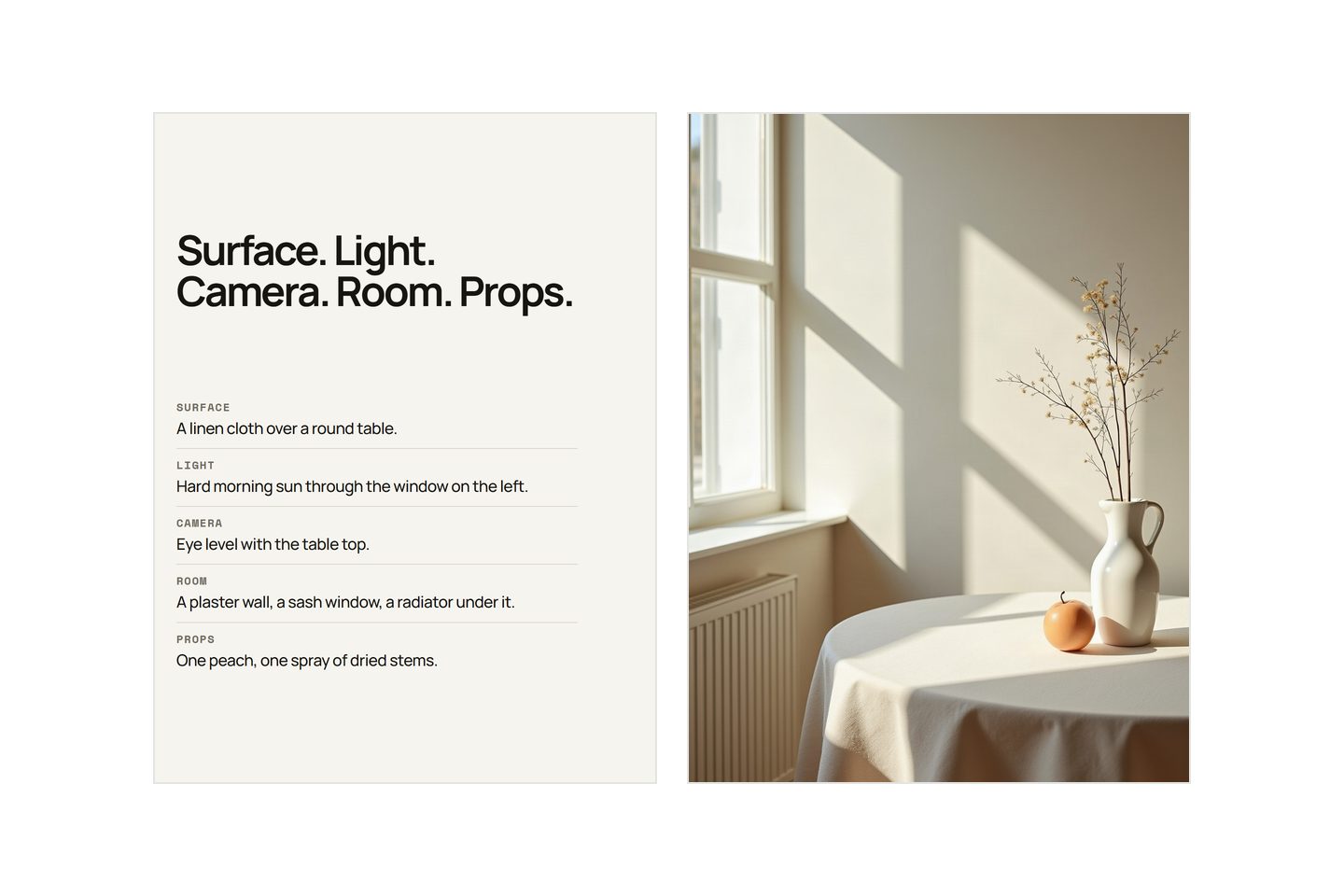
An empty box that says describe what you want is not a test of effort. It is a test of vocabulary. What to write in an image prompt for a product is, nearly always, five things about the world around the product: the surface it stands on, where the light comes from, how close the camera is, what room it is in, and what else is on the table. The product itself needs no describing. The tool already has a photograph of it.
Nobody is born knowing that soft light from the left is a thing you are allowed to ask for. It is. Here is the rest of the vocabulary, then four descriptions taken apart.
The change in one sentence
Stop describing the product and describe the place it is standing in, along five concrete axes and one weak one.
Surface. What the product stands on, named as a real material: unpolished travertine, oiled oak, a linen tea towel, a painted windowsill, brushed steel. The word surface on its own gives the model nothing to anchor to, and an unanchored product floats above its own shadow.
Light. Two words carry most of this, and the first is direction. From the left, from behind, from a window at the side. Direction decides where the shadow falls, and the shadow is what tells a viewer the product is in the room rather than pasted onto it. It is the single most useful word you can add.
The second is hardness, and the edge of the shadow tells you which one you have. Hard light throws a shadow with a crisp edge you could trace: midday sun, a bare bulb, a phone flash. Soft light throws one that fades out over a few centimetres and never quite ends. Time of day is worth a third word, because late afternoon means long low shadows and a warm cast, while mid morning means short shadows and neutral colour. If you are working on white and it keeps coming back grey, that has a separate cause.
Distance and angle. Four positions do most of the work. Eye level with the surface looks like you are standing at the table, and it is the honest default for anything a person picks up. Straight down from above is for arrangements and sets. Close is for material: weave, grain, the edge of a seam. Wide is for belonging, the shot that says which kind of home this lives in. Name one, or you get eye level and centred every time. Six pictures from one product is mostly this axis, moved on purpose.
Context. The room around the surface, which is the difference between a background and a place. A background sits behind the product. A place carries on past the edge of the frame. Give it a wall, and something further back and out of focus. On a kitchen counter with a tiled wall behind and a window out of frame to the left is a place. Kitchen background is a wallpaper.
Props. One or two things a person would plausibly have left there: a folded cloth, a used teaspoon, a paperback face down. They give scale, because everyone knows how big a teaspoon is, and they imply somebody was here a minute ago. Three or more and the eye starts hunting for the subject, and your product has to win an argument it did not need to have.
Mood. The weak axis. Calm, premium, editorial: these push a little, mostly on colour temperature and clutter, and decide nothing on their own. Two people who ask for premium have different pictures in their heads. Use them last, or swap them for a surface, a direction or a prop.
Some tools make these calls for you: Kloti takes an uploaded product and works out the scene, the styling and the words. Knowing the axes is what lets you say whether what came back is right.
Both versions, verbatim
The weak version in each pair is roughly what people write before anybody hands them words.
First, a bar of soap.
professional product photo of a bar of soap, photorealistic, 8k,
high quality, award winning, beautiful lighting, #F2E8D8 background
The soap on an unpolished travertine ledge, a folded grey linen
cloth behind it, a brass tap at the edge of the frame. Soft light
from a window to the left, late morning, so the shadows are short,
fall to the right, and fade out rather than ending sharply. Camera
at eye level with the ledge. A tiled wall a foot behind, out of
focus. Warm cream and grey.Second, a candle in a glass jar.
luxury scented candle, cozy atmosphere, cinematic, highly detailed,
professional photography, trending
The candle on a dark walnut side table beside a low armchair, early
evening. One warm lamp to the right, small and close, so the shadow
of the jar runs left across the table with a defined edge. Camera
just above the rim, near enough to see the wax surface. A paperback
face down next to it. The rest of the room dark but legible.Candles bring their own problems, mostly glass and flame, but the description is built the same way.
What moved and what did not
Compliments came out. Photorealistic, 8k, high quality, award winning, professional, cinematic, trending. None of them describes the content of a picture, so at best they are dead weight. At worst they steer, because 8k and cinematic sit in captions attached to 3D renders and heavily graded stills, which is the plastic look people complain about. Professional product photo is the caption on the centred-object-on-white default, so asking for it asks for the average. Words that name something a camera does are the exception: shallow depth of field, fine grain, natural light.
The hex code came out. Models do not read hex as colour, and one will occasionally draw the characters into the picture as visible text. Colour names work, including compound ones: warm cream, putty grey, deep olive. One warning, warm on its own tends to come back pink.
The five axes went in, and each bought something. The travertine gave the soap a shadow to sit in. The window direction gave every shadow one origin. Eye level put the viewer at the ledge rather than above it. The tiled wall turned a backdrop into a bathroom. The tap and the cloth said somebody uses this.
| Instead of | Write |
|---|---|
| photorealistic, 8k, high quality | shallow depth of field, fine grain, natural light |
| beautiful lighting | soft light from a window on the left |
| #F2E8D8 | warm cream |
| cozy atmosphere | one warm lamp, early evening, the rest of the room dark |
Nothing describes the product. Neither strong version says what the soap looks like or how tall the jar is. The tool has the photograph. Describing it again hands the model a second and worse source for the same information, and the two compete. What comes back is nearly your product, which looks fine until you hold it next to the real thing. Name the noun once so the sentence has a subject, then spend every other word on the world.
Where it stops working
Length. Past roughly a paragraph, clauses compete instead of accumulating. Nine props and three light sources produce an average of themselves and look like one.
The input photograph. This is the real ceiling. If your photo was lit hard from the right, asking for soft light from the left asks the model to argue with pixels that already exist, and it will either relight badly or quietly redraw the product. A redrawn product is a different product. The same goes for a low-angle photo you want in an overhead flat lay, and for a label too small and blurry to read, because no description makes unreadable type readable.
When you hit that one, more words will not help. Photograph the product again: whole, flat on, in focus, against a plain wall, in daylight with no direct sun on it. A phone is fine, and that one input improves every scene afterwards.
What to try on your own product
Write the five axes as five clauses, in order: surface, light, camera, room, props. Read it back and delete every word that is a compliment rather than a fact.
Then change one axis at a time. Move the camera and leave the light alone, or swap the surface and keep everything else. Change four things at once and a better picture teaches you nothing you can use again.
Keep the ones that worked, written out in full, in a note on your phone. Most products live in about four places: the counter they are used on, the table they are given on, the shelf they are stored on, the bag they are carried in. Write those four down and the box is never empty again.
If there is no object at the middle of this, the five axes still work but the subject moves: the place, the job as you left it, the tools, the result. What to post when you do not sell a product is written for that case.
Written by the Kloti team. Kloti writes and designs a carousel about your work, and the caption to post it with. The pictures on this page were generated in Kloti.