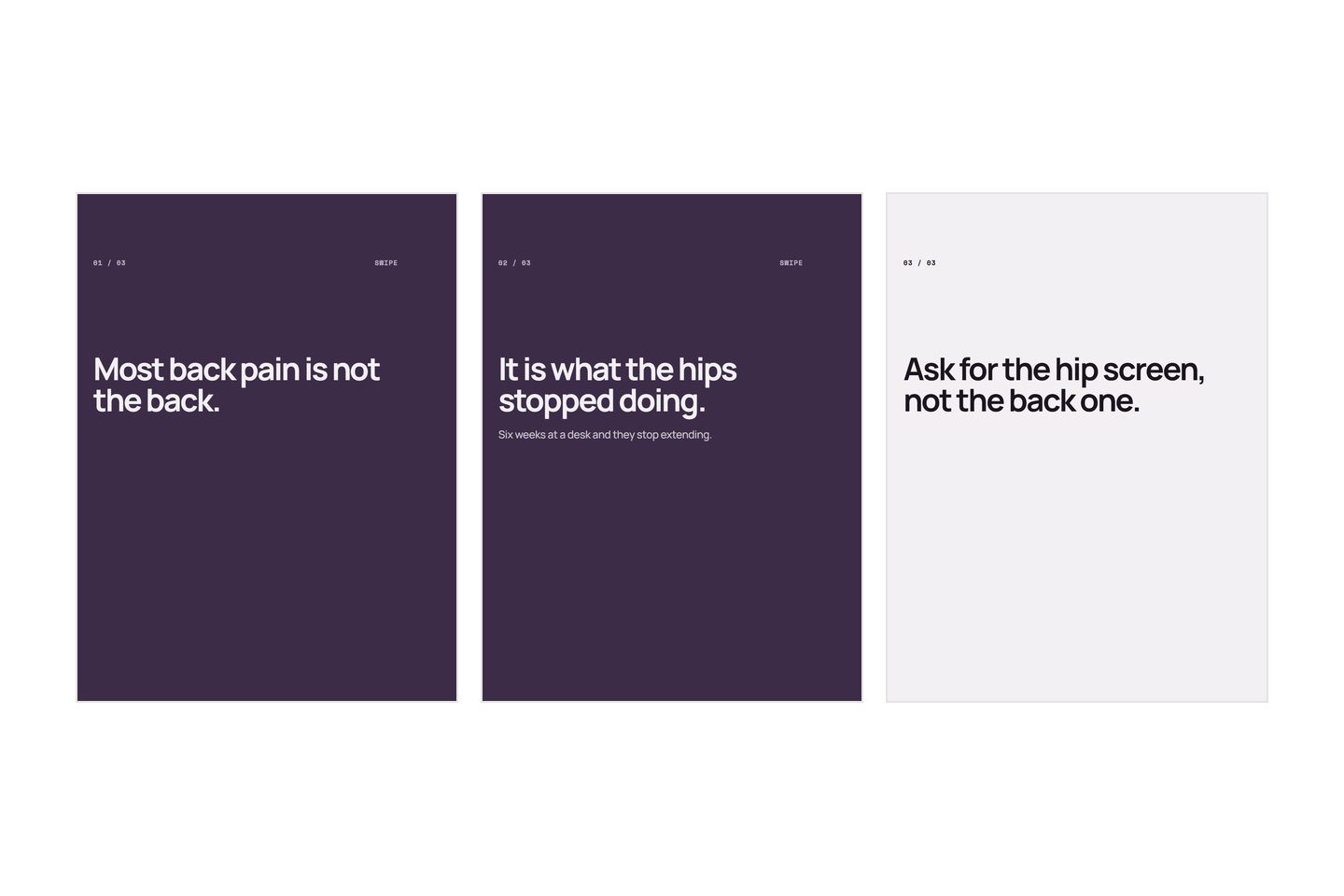
Post the things you know that your customers do not. If you fit kitchens, teach piano, treat backs, walk dogs or do somebody's books, your material is not an object, it is the accumulated set of corrections you make every week: what people get wrong, what they should have asked for, what the expensive mistake looks like. That is more postable than a product, not less, and it needs no photograph at all.
The difficulty is that almost all advice about posting assumes a thing on a table. Here is the version that does not.
What makes this hard
Three things, and the first one is mostly a confidence problem.
Your expertise does not feel like content. The thing you would post is so obvious to you that it seems insulting to say out loud. It is not obvious to anybody else. "Most back pain is not the back" is a shrug to a physiotherapist and news to almost everyone else, and the gap between those two reactions is where every good post you will make lives.
You have nothing to photograph, and everything you read assumes you do. Guides tell you to shoot the product on a plain ground, in daylight, from six angles. There is no product. So people fall back on stock photographs of smiling strangers in an office, which read as an advert for nobody in particular, or on a logo on a coloured square, which reads as nothing at all.
The work happens in places you cannot show. Inside somebody's house, in a treatment room, in a spreadsheet, in a lesson with a child in it. Half of what you do is confidential and the other half is unphotogenic. This is real and it does not go away.
The way through all three is the same: stop looking for something to picture and start looking for something to say. A carousel of words on a plain colour is a complete post, and for this kind of work it is often the better one, because the argument is the thing being sold.
The posts you already have
You have more than you think. These are the shapes that come up again and again for work with nothing on a shelf, and most people can fill several of them in one sitting.
| The shape | Where it comes from | Example opening |
|---|---|---|
| The correction | The thing customers believe that is wrong | "Most back pain is not the back." |
| The wrong ask | What people request versus what they need | "Ask for the hip screen, not the back one." |
| The expensive mistake | What you get called in to fix | "By the time the ceiling stains, it has been leaking for months." |
| The decision | Something you changed, and why | "We stopped doing Saturday callouts." |
| The order of operations | What has to happen first, that people skip | "Do not choose tiles before the floor is levelled." |
| What it actually costs | The real breakdown, honestly | "Two thirds of a rewire is labour, and here is why." |
| Who it is not for | The customers you turn away | "If you want it done in a week, we are the wrong people." |
Every one of those is an argument, and an argument is what a carousel is for. None of them requires a photograph.
The last two are the ones people flinch at and they are usually the strongest. Saying who you are not for is the clearest signal you can send that you are for somebody, and it filters your enquiries before they cost you a phone call.
What goes in each one
Take the sentence from your own week
The best posts come from what you already said out loud to a customer in the last fortnight. Not a topic, a sentence.
Keep a note on your phone. Every time you explain the same thing for the third time, write down the sentence you used. Those sentences are already tested: they are in plain language, they answer a real question, and you know they land because you watched somebody understand them.
Then the carousel writes itself in three or four lines. The claim. The reason behind it. What it means for them. What to ask for. That is a whole post and it took the length of a conversation you already had.
Words on a colour, not a stock photograph
Type on a flat ground reads as a statement, because the eye has nothing to do except read. A stock photograph of a generic professional reads as an advert, and worse, it reads as an advert that could belong to any of your competitors.
If you want a picture, the honest ones are available to almost everybody: the finished job, the tools laid out, the thing you removed, the whiteboard, the hands doing the work, the before and after. A photograph of a finished bathroom taken on a phone in daylight beats any stock library, because it is yours and it is proof.
What does not work is one picture repeated across five slides, which is the catalogue failure in a different costume. Where a photograph would help and you only have one, put it on the slide it proves something on and let the others be words.
Say the number
The single biggest difference between a service post that works and one that does not is specificity. "We are thorough" is an adjective and gives a reader nothing to check. "We take the boiler cover off on every visit, which adds about twenty minutes" is a fact, and a reader can decide what they think about it.
Adjectives are what people write when they have not decided what the post is about. If you cannot get from the adjective to a fact, the problem is upstream of the carousel, in never having written down what you actually do.
Mistakes
- Posting about your business instead of your work. Anniversaries, team photographs, "we are hiring", the new van. These are fine occasionally and they are about you. The posts that get saved are about the reader's problem.
- Motivational quotes on a gradient. Universally available, therefore worth nothing, and they say you had nothing of your own to say that week.
- Waiting until you have something to announce. Most trades and practices post four times a year, all announcements. The correction posts are available every week and they do not require anything to happen.
- Hiding the price because it is complicated. "It depends" is a real answer and it is also a post: what it depends on is exactly the thing your customers do not understand.
- Being vague to seem professional. Vagueness reads as hedging. Naming the thing you will not do reads as confidence.
- Making it about the product you do not have. If the tool or the template you are using keeps asking what you sell, ignore the question and answer a different one: what did you fix this week.
That last one is a real friction and worth naming honestly. We build Kloti, a carousel tool, and it was built around products first before it was widened, so this is a correction we have had to make in our own work rather than an observation about somebody else's.
What differs by platform
Less than you would expect, because words on a colour survive everywhere.
The main difference is what a profile grid does to you. A visitor who lands on your page sees first slides only, in a tight square crop, so a run of posts whose openings are all your logo reads as a wall of nothing. Openings that are sentences read as a body of work, which matters far more for a service than for a shop: somebody choosing a physiotherapist is reading your grid as evidence.
Local search behaves differently too. For a trade, the post that gets found is often the one naming the specific problem in specific words, because that is what somebody types at eleven at night. "Why is my radiator cold at the top" is a better opening than "heating services".
And the caption carries more weight here than it does for a product, because the detail is the sale. A carousel can hold the argument in eight words a slide; the reasoning, the caveats and what it costs go underneath, and what to write in a carousel caption covers the shape of that.
Start with the correction shape. One thing your customers get wrong, the reason, and what to ask for instead. You have said it out loud this month already.
Written by the Kloti team. Kloti writes and designs a carousel about your work, and the caption to post it with. The pictures on this page were generated in Kloti.