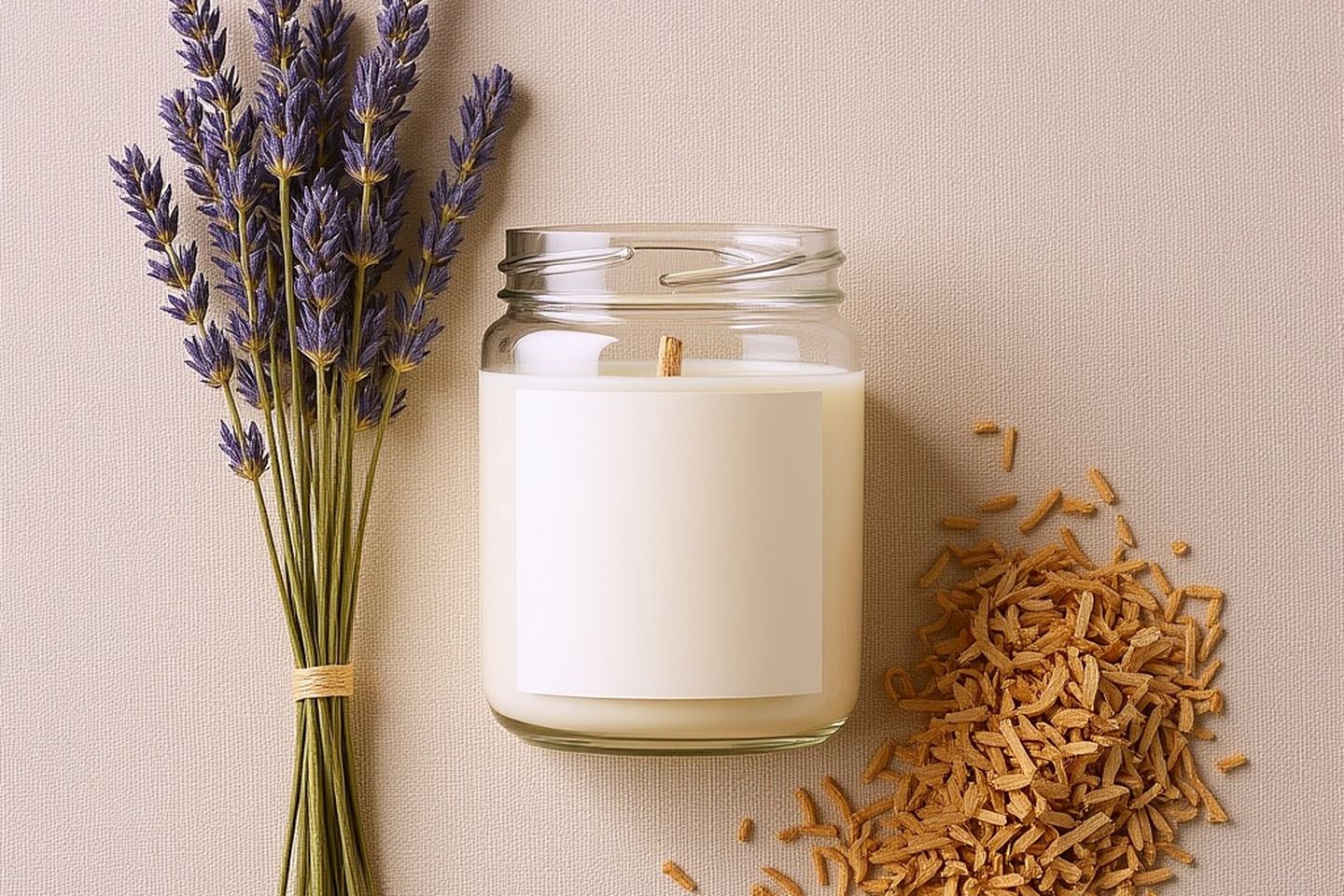
Photographing candles is hard for two material reasons, neither of which is your camera. Glass shows the room back to you: the window, the ceiling, the dark shape of a person holding a phone. Wax is translucent, so light aimed at the front of a jar lights only the surface, and the wax underneath reads as flat grey. Fix those two and most of the job is done. Light from behind and to one side, and watch what stands opposite the glass rather than adding lamps.
The rest is detail, plus the part nobody has a method for, which is photographing a smell.
What makes candles hard to photograph
Glass is a mirror with a lens in it. A curved jar gathers a wide arc of the room into a narrow band, so a window two metres away becomes a hard bright stripe, and you become a dark shape with your phone screen bright in the middle of it.
Wax is translucent, which changes where the light must come from. Some of the light that lands on a jar enters the wax, scatters a few millimetres and comes back out, which is why a candle looks lit from inside when it is lit from behind. Light the front of a jar and you see the surface only: unpigmented soy reads as flat grey cream, and brightening will not fix it, because the problem is direction rather than quantity.
A flame and the jar beneath it are two different exposures. A flame is tiny and very bright, and your camera picks one exposure for the whole frame. In a dark room the flame is far brighter than everything around it, so exposing for the jar blows it into a white blob with a bloom: no teardrop, no orange base. Expose for the flame and the jar goes black. Shoot in daylight and the opposite happens: the flame is now dimmer than the room, and a lit candle photographs as an unlit one with a smudge above the wick.
The gap between those two failures is narrower than people expect. You want ambient light a few stops below the flame, not far below it: late afternoon with the curtains half drawn, an overcast day with the lamps off, twenty minutes after sunset.
An unlit candle is a jar of wax, and a lit one is a claim. Buyers read listing photos as instruction, so a candle burning next to dried flowers is an arrangement somebody will copy at home. A lit shot also sets expectations you must meet: flame size, how far the glow reaches, how wide the pool gets. Decide which images are lit rather than lighting everything.
And the product itself cannot be photographed. Nobody smells a picture. Scent arrives by association, which is a craft problem rather than a styling afterthought.
The shots a candle listing needs
Six, doing different jobs. The first carries the search result; the last is seen by people already reading.
- The plain jar, unlit, label centred. Straight on, at label height, clean ground, nothing in the glass. It has to survive at the size of a stamp.
- The lit shot. One is usually enough, and it is the one people save.
- Something for scale. Ounces and grams mean nothing to most buyers. A mug or a hand settles it.
- Top down into the wax. Wick count, wick type, wax colour and surface: real questions, especially for wood wicks.
- The scent picture. The still life that stands in for the fragrance.
- One detail. The lid, the label texture, the vessel washed out and reused.
Melts and diffusers take the same list with substitutions. A sealed clamshell is dull, so photograph broken segments and wax pooling in a warmer. Reed diffusers are tall and thin, so the silhouette is the picture: shoot vertical and show the liquid level. A room spray shows nothing until you backlight the mist against dark, the one shot here where the fragrance is really in frame. If you sell a single product, there is more in it than most people take.
Setups you can build with a window and a phone
The base position. Table within a metre of a window, jar placed so the window sits behind it and off to one side. Light then travels through the wax at the edge of the jar and it glows instead of sitting there grey. The label will be too dark now, so stand a sheet of white card thirty centimetres away on the shadow side and move it while watching the label, not the meter.
The reflection check. Put your eye where the lens will be and look at the glass. Everything visible in it is in the photograph: you, a doorway, a ceiling light. Hang a dark towel over your chest, or prop the phone on books and shoot on the timer.
The lit shot. Trim the wick to about six millimetres or you get a tall smoky flame with a mushroom on top. Light it and wait: the flame settles taller and steadier after a couple of minutes, and twenty minutes gives a wet melt pool that catches light. Keep it out of draughts, or the flame smears at the shutter speed a phone picks in dim light. Tap the jar to focus, drag the exposure slider down until the flame stops being a blob, and accept a darker jar. Clean the lens first: one fingerprint turns a bright point into haze across half the frame.
The label shot. A wrapped label is a cylinder, and two things go wrong at once. The left and right thirds turn away from the lens, so letters compress and the baseline bows: only the middle of the curve reads properly, and the wordmark has to sit dead centre. Those edges also sit a centimetre or two further from the lens than the middle, which at close range exceeds the depth of focus, so they go soft. Back off to half a metre, use the 2x lens if you have one, and keep the phone level with the label: shooting downward adds a trapezoid to the curve. If a highlight lands on the name, rotate the jar a few degrees: a reflection moves twice as fast as the jar.
The scent still life. Three levers, and the literal ingredient is the weakest.
Colour temperature sets the category before anyone reads a word. Warm, low and amber says spice, wood, vanilla, evening. Cool and bright says citrus, mint, linen, morning. A sea salt candle shot in lamplight reads as a bakery, and the description spends its life arguing with the picture.
Texture does more than props do, because people guess smell from surfaces.
| Scent family | Light | Surfaces that carry it |
|---|---|---|
| Citrus, mint, marine | Cool and bright, short shadows | Wet glass, pale stone, white cotton |
| Wood, smoke, leather | Low and warm, one hard side light | Raw timber, dark linen, matte clay |
| Vanilla, spice, gourmand | Warm and dim, deep shadow | Old paper, brass, wool, worn wood |
| Floral and powder | Soft and high key, little contrast | Bone paper, unglazed pottery, cotton |
| Herbal and green | Daylight, slightly cool, clean | Damp stone, glazed tile, clear glass |
The third lever is visible air. Steam, backlit mist, or a curl of smoke from a wick you blew out ten seconds ago. That last one is the nearest thing to a photograph of a smell, and it wants a dark background with a light behind it.
Mistakes that are specific to this category
The jar on white that came back murky. Glass drags grey in from two directions, its own shadow and the dull surface of unlit wax, and that is a lighting problem rather than an editing one.
Colour that will not match the parcel. White balance pushed warm turns cream wax yellow, and retouching out soy frosting hides something that grows back on the shelf. Buyers compare the candle against the picture, and one honest line in the description prevents more returns than a clean surface does.
Props that contradict the notes. Dried orange slices beside a driftwood and sea salt candle tell a buyer the opposite of the label.
What changes by platform
Etsy shows your first image in more than one shape depending on where it appears, and its own image guidance asks for a horizontal or square first photo, with the subject centred and enough margin to survive a crop, checked August 2026. For a tall jar that means framing wider than feels right, because a crop that clips the lid in search costs you the click.
Instagram is the opposite shape and rewards the lit, atmospheric frames a listing cannot lead with, and your own store is the only place you fully control the crop. So shoot at the largest size your phone offers and crop per destination, rather than composing tight and finding out the platform wanted room. The numbers that actually matter are a short list.
Written by the Kloti team. Kloti writes and designs a carousel about your work, and the caption to post it with. The pictures on this page were generated in Kloti.