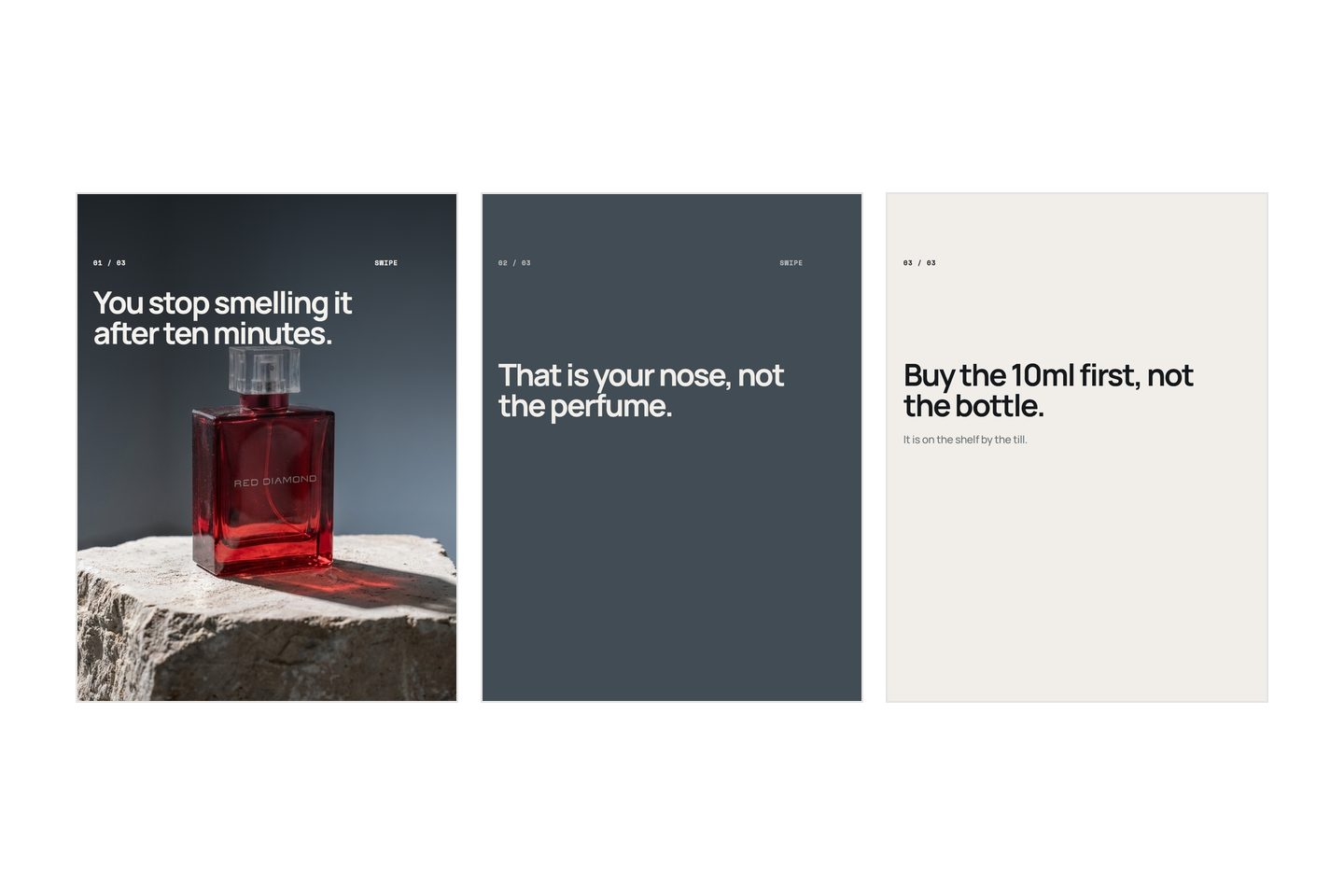
A save is somebody keeping a thing they expect to need later, so it is earned by a slide that is still useful with the rest of the post taken away. A share is a different action with a different cause: somebody either saying something about themselves in public, or handing your post to one specific person whose problem it solves. A like is neither of those. It costs the reader nothing, and it is the number most people spend their time on.
Here is what each of the three is actually made of, and what that changes about the slides.
Why a like is not a signal you can use
A like is a reflex. Half a second of thumb, no consequence, nothing to come back to. Ask anybody what they liked last Tuesday and they cannot tell you, which is the whole story.
A save has a cost and an intention behind it. The reader is putting your post into their own folder, which is a small act of tidying, and they are predicting that they will want it again. A share costs more still, because the person doing it is spending a little of their own standing on you.
That difference in cost is the reason the two are worth designing for. There is also a ranking argument, and it is worth stating carefully. Instagram's own description of how it orders Explore says that "the most important actions we predict in Explore include likes, saves, and shares", in a newsroom post published in 2021 and still up when we read it in September 2026. That is the company describing its own system, which is the best available source, and it is five years old.
What you should not build a week's work on is the arithmetic that gets quoted around it. You will read that one save is worth ten likes, or that one send is worth fifteen. Nobody outside the company is in a position to measure that, and the people publishing the numbers did not.
The useful reason to want saves and sends does not need the ranking argument at all. They are the only two actions with a second life. A saved post gets opened again, by somebody who has already decided you were worth keeping. A sent post arrives in front of somebody who had never heard of you, with a recommendation from a friend attached to it. A like is finished the moment it happens.
What a save and a share actually are
Four actions, not three, because sharing is two unrelated jobs under one word.
| The action | What the reader is doing | What earns it |
|---|---|---|
| A like | Nodding | Agreement, or politeness |
| A save | Filing something they expect to need | A slide that still works with the post taken away |
| A share to their story | Saying something about themselves in public | One sentence they would be willing to have said |
| A send to one person | Solving a named person's problem | A post narrow enough that a face comes to mind |
The bottom two rows look similar and are opposites. A story share is public and is about the sharer: they are using you as a way of describing themselves. A send is private and is about the recipient: they are using you as a way of helping one person.
The send is the one that grows anything, because it is the only route by which a stranger meets you with somebody they trust standing behind the introduction. It is also the one nobody writes for, because writing for it means giving up on addressing everybody at once.
None of these can be requested. "Save this for later" on a post with nothing worth having later does not produce saves; at best it reminds somebody who had already decided. The instruction is not the cause.
What each one needs on the slides
The slide that gets saved
Take one slide out of your last post, look at it tomorrow with nothing around it, and see whether it still tells anybody what to do. That is the test, and it is harsh on purpose, because it is the situation a saved post is opened in: weeks later, out of order, with no memory of the four slides that led up to it.
What survives it: a sequence in the order it has to be done, quantities, a rule with a number in it, the exact words to ask for, the things to check before agreeing to something, a list somebody will work through with a pen.
What does not: an opinion, a mood, a photograph you are pleased with, and anything with a deadline. An offer that ends on Sunday cannot be saved, because a save is a bet on later and there is no later.
Then there is a mechanical detail almost nobody plans for. The save is on the post, not on the slide. So the reader has to have met the reason to save it before they stopped swiping, which means the useful slide cannot be the last one. Put it third. Most people who see a post never reach the end, and nobody files something they did not see.
That is also the reason a picture sliced across several slides is a poor candidate for saving, which is worth knowing before you spend an evening on a seamless carousel: half a photograph is not useful on its own by construction.
The slide that gets sent
Sharing in public is self-description. Somebody putting your slide on their story is saying "this is what I think", and they will not do that for a sentence they would not say out loud. Almost everything written to sound professional fails here. "Quality you can trust" is not a sentence any human being repeats.
For the private send, the test is different and it is the most useful question in this post. While you are writing, can you name one real person who should see this? Not a category of person. A person, with a name.
If nobody comes to mind for you, nobody will come to mind for a reader either, and that is why narrow beats broad even though it feels backwards. "Five tips for a healthier back" is addressed to everybody and gets sent to nobody. "If you work at a laptop on a kitchen chair, this is the one thing to change" has a face attached to it before the reader has finished the sentence. The same move applies to almost any subject, and where the material comes from is mostly a matter of remembering specific conversations rather than inventing topics.
Slide two has to stand alone
This is the structural fact about carousels that almost nobody designs for.
Adam Mosseri, who runs Instagram, described the behaviour in a video in October 2024, quoted here by Social Media Today: "if someone sees your carousel post but they don't swipe, we'll often give that carousel a second chance and automatically move to that second piece of media for the viewer."
Read what that means for the writing. For some share of the people who see your post, slide two is slide one. They never get the opening you spent the effort on. They arrive in the middle, cold.
The usual advice, including ours, is that slide one exists to make slide two worth reaching, and that still holds: a first slide that answers itself is still the most expensive mistake available. What the advice misses is that slide two now has two jobs, and they are compatible.
The practical version is a reading test. Cover slide one and read slide two out loud. If it begins with "so", "that is why", "and", or a "this" whose meaning is sitting on the previous slide, it cannot open a post, and every second chance you are given is wasted on it. Rewrite it so it stands up alone and still answers slide one. That is usually possible in one pass, it costs nothing, and it leaves you with two openings instead of one.
Mistakes
- Asking for the save instead of earning it. The words "save this" are not a mechanism. They are a label on a post that either deserves them or does not.
- Putting the useful slide last. The instinct to build to a finish is right for an essay and wrong here. A reader who leaves at slide four never had the chance to file anything.
- Writing for everybody. A post addressed to an audience gets an audience reaction, which is a like. A post addressed to one situation gets forwarded to the people in it.
- Posting nothing but deadlines. Offers, events, opening hours, restocks. All legitimate, none of them saveable, and an account made only of them has nothing sitting in anybody's folder.
- Reading engagement as one number. Most dashboards add likes, comments, saves and shares together and show you a total. Likes are the largest of those and the least informative, so the total mostly measures the thing you care least about. Look at saves and sends on their own, post by post.
- Trying to go viral. Nobody can do it on purpose, including the accounts selling instructions for it, and a post built to be spectacular is usually not a post built to be useful. What is actually available on a Tuesday is a post worth keeping, and that is a decision rather than a lottery.
What differs by platform
The names change and the mechanic does not. Every large platform has a private folder people re-open and a private forward you can never see the far end of. Anything built to be useful out of context works in all of them.
The blindness of the send is worth planning around. You get a count and never a name, so a post that is being forwarded hard can look quiet on the surface, get judged a failure, and never get made again. If you post something narrow and the comments are silent, look at the sends before you conclude anything.
The second-chance behaviour above is specific to Instagram carousels. Do not carry the assumption anywhere else, and do not assume it will still be true next year: it is a decision somebody at the company made, and decisions like that change without an announcement.
The one habit that travels is writing down what somebody would need later. That material makes a carousel, and whatever will not fit on a slide makes the caption underneath it.
So take your last post and ask two things of it. Which slide would still be useful with the others deleted, and who exactly would you have sent it to. If neither has an answer, it was a like and nothing more. We build Kloti, a carousel tool that takes one sentence and writes the slides around it, and it will put the useful one early and give slide two an opening of its own. What is worth keeping still has to come from you, because you are the only one who knows it.
Written by the Kloti team. Kloti writes and designs a carousel about your work, and the caption to post it with. The pictures on this page were generated in Kloti.