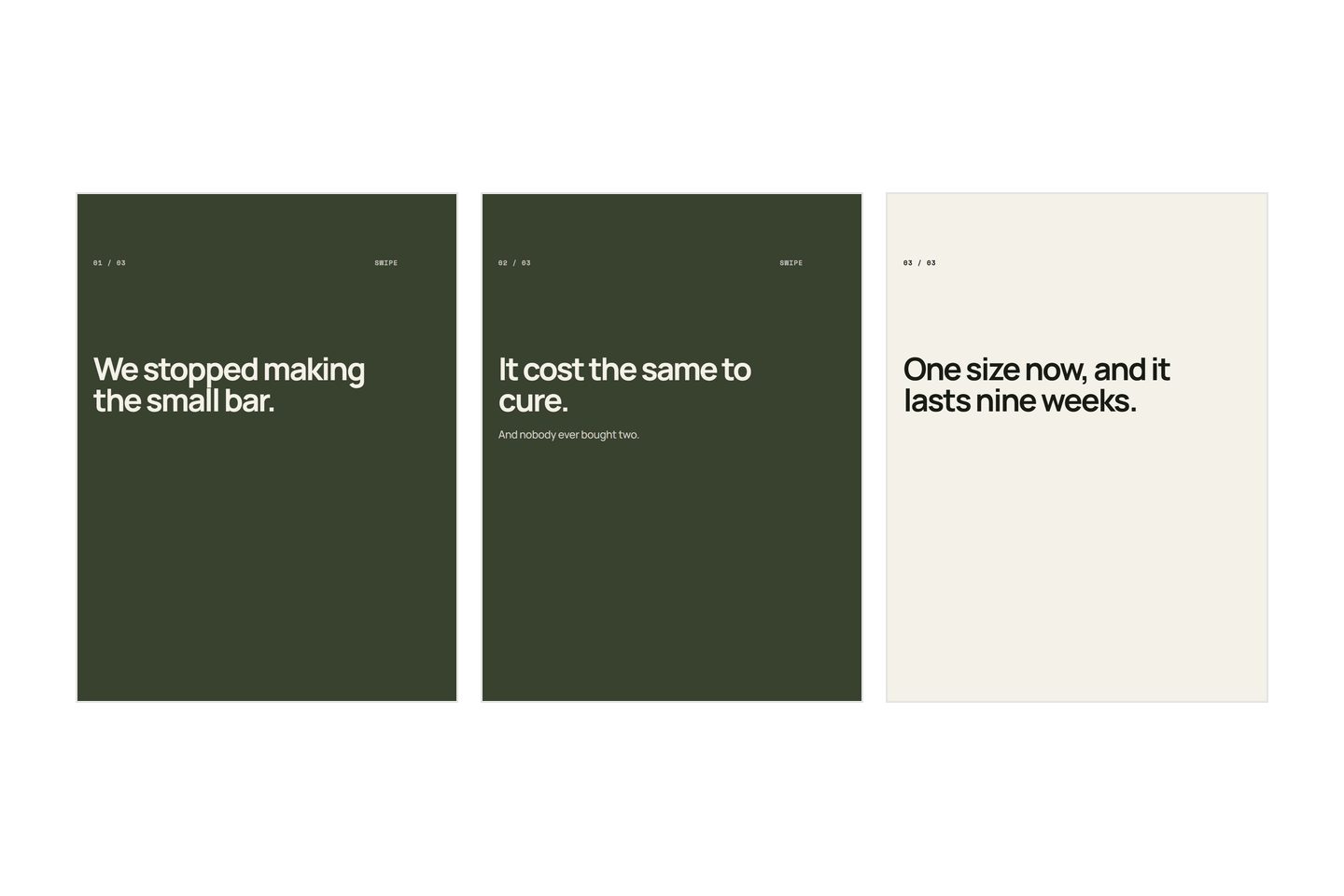
You have not run out of things to say. You have run out of announcements, which is a much smaller category and the only one most people think to look in. The material is the ordinary content of your week: the question you answer for the third time, the thing you find too obvious to mention, the mistake you fixed, what a first visit actually looks like from the other side of the desk. Here is where to find it, and how to turn a month of it into posts in one sitting.
What makes this hard
You are looking for news, and news is rare. Most people treat a post as an announcement, so the only qualifying events are a new thing, an offer, an award, or a holiday. That is maybe six events a year and you need a hundred posts, so the well runs dry by February. Nothing was wrong with the well. You were fishing in the wrong part of it.
The good material does not feel like material. Everything you know is boring to you, because you have known it for years and so has everyone you work with. The sentence you would be slightly embarrassed to post is almost always the one worth posting, and that is not a confidence trick: it is a real gap between what is obvious inside a job and what is obvious outside it.
An idea is a sentence, not a topic. "Something about pricing" is not an idea, it is a folder. You cannot make a post out of it, so you sit there feeling blocked while holding four perfectly good ideas that have not been written as sentences yet. Almost everybody who says they have no ideas has topics.
And the bar is set impossibly high. Waiting until you have a great post is why you have no posts. Posting a decent one on Tuesday teaches you more than a month of thinking about it will.
Where the posts come from
Six sources, and every one of them refills on its own. Between them they will produce more than you can use.
| The source | Where to look for it | What the opening sounds like |
|---|---|---|
| The question you are asked most | Your inbox, your messages, the first two minutes of every call | "Everybody asks whether it needs doing every year. Here is the honest answer." |
| The thing too obvious to say | Whatever you would feel silly explaining | "Bread does not go stale in the fridge. It goes stale faster." |
| What you got wrong and fixed | Your own past decisions | "We used to take bookings by phone. It cost people appointments, and here is how." |
| What a first time actually looks like | The thing you do so often you forgot it is unfamiliar | "Nobody touches you in the first session. It is twenty minutes of questions." |
| The decision before anybody buys from anyone | The choice a person has to make before you are even a candidate | "Before you choose a bookkeeper, decide whether you want them doing your invoices too." |
| The quiet week | The week nothing happened | "Nothing broke this week, so here is what maintenance actually looks like." |
The fifth one is the one people skip and it is quietly the best. A post that helps somebody make the decision that comes before hiring anybody at all is useful to a person who is not ready to buy, which is most of the people who will ever find you. It also happens to be the post that gets sent to a friend, because it settles an argument rather than advertising a service.
The sixth is the one people cannot believe. A week where nothing happened to you is somebody else's first week. The routine you find dull is the thing a stranger has never seen.
If none of the six lands, the other angle is to stop looking for events entirely and start with what you know that your customers do not, which is the version for work with nothing on a shelf.
Building a month in one sitting
Ideas do not arrive on a schedule and posts are due on one. The fix is to separate the two jobs completely: one sitting to find the material, then a month of just making things.
The sitting itself
Twenty minutes, one page, phone face down. Take the six sources above in order and write three lines under each. Eighteen lines. You will get stuck on two of the six and produce five under another, which is fine.
Do not judge anything while you are writing. The sorting comes after, and mixing the two is what turns a twenty minute job into an evening.
Sentences, not topics
This is the rule that makes the difference, and it is worth being strict about. Every line has to be a sentence you could say out loud to a customer standing in front of you.
"Pricing" is a topic. "We charge for the callout even if the fix takes five minutes, and here is why that is cheaper for you" is a sentence. The first one produces nothing on Tuesday morning. The second one is already most of a post, because the argument is finished and only the making is left.
The quickest way to get sentences instead of topics is to remember an actual conversation. Not a subject you should cover, a thing you genuinely said, to a specific person, recently. Those sentences are pre-tested: they are in plain language, they answer a real question, and you watched somebody understand them.
Ordering them, and why the dull ones go first
Sort the page by how often you have said each line out loud. The one you have repeated most goes first.
That feels backwards, because the most repeated line is the one you are most sick of, and being sick of something is a terrible guide to whether it is worth saying. You have said it two hundred times to two hundred different people who had each never heard it. Boredom is a measure of your exposure, not theirs.
Twelve lines is a month at three posts a week. Keep the rest of the page, because next month's sitting starts with what is left rather than with nothing.
Then decide the format last, once per post, when you already know what it says. Some of those sentences want eight slides and a caption, and the order that saves the most work covers that. A few of them want to move, and a reel out of photographs you already have is how to do that with nothing filmed. Choosing the format before the sentence exists is how people end up with a beautiful template and nothing in it.
Mistakes
- Hoarding the good one. The best idea on the page gets saved for when there is time to do it justice, and it is still there in March. Post it this week, imperfectly.
- Turning a sentence back into a topic. "Five tips for choosing a plumber" is what a specific idea becomes when somebody loses their nerve. The specific version was better and it was already written.
- Scrolling competitors for ideas. Do it long enough and you produce the average of your market, which by definition nobody notices. Your own week is the only source nobody else has.
- Batching a whole quarter. Three months of scheduled posts written in one evening will include things you no longer believe by week six, and it removes the one advantage you have over a big account, which is being able to post the thing that happened yesterday.
- Confusing a content calendar with content. A grid of themed days is a schedule. It contains no sentences, and the sentences are the work.
What differs by platform
The list is format neutral and travels everywhere, but what each place rewards is different, and one of those differences is worth planning around.
The correction posts and the "what a first time looks like" posts get saved and sent to somebody else. The announcement gets a polite like from people who already know you. If your account is not growing, look at what share of your last twenty posts could ever have been forwarded to a friend, because forwarding is the only mechanism by which a stranger meets you.
Search behaves differently again. People type the question, not the category. "Why is my radiator cold at the top" gets found for years. "Heating services" gets found by nobody, and that gap is an argument for keeping your posts in the exact words your customers use, including the clumsy ones.
And the same page feeds more than one thing. A line that makes a decent carousel makes a decent email and a decent answer on your own website. That is the real return on the twenty minutes: you are not writing posts, you are writing down what you know, which was going to be useful anyway. The narrower version of this, one subject with no new events attached to it, is what to post when nothing new has happened.
Do the twenty minutes today. Six headings, three lines each, sentences only. We build Kloti, a carousel tool that takes one of those sentences and writes the slides around it, and it can only start once the sentence exists.
Written by the Kloti team. Kloti writes and designs a carousel about your work, and the caption to post it with. The pictures on this page were generated in Kloti.