You have nothing new to sell, a post is due, and the same product goes up again at a slightly different angle. The way out is not a new product and it is not a better picture. It is to stop posting the object and start posting what you know about it. One product is one object and about thirty subjects, and most of those subjects have never left your head.
Photographs run out. Facts do not. The whole problem is that nobody ever told you the second half.
The artifact
Open your own grid and look at the last nine squares. The same item, centred, on the same surface, at nine angles that differ from each other by about fifteen degrees. Under each one, four adjectives and some hashtags. The most recent is the one you like least, because by then you had run out of angles and photographed the underside.
Two symptoms travel with it. Posting gets slower, because each post now costs an hour of deciding and ten minutes of doing. Then the gaps get longer, the account goes quiet for three weeks, and you come back with an apology post, which is the only genuinely new thing said in a month.
What looks wrong
Almost everybody reads this as a supply problem. Not enough product, therefore nothing to post about. What follows is a second colourway, a bundle, or a whole new line, none of which are quick and all of which cost money you were not planning to spend on marketing.
The second reading is that it is a skill problem. Better pictures, a lamp, a tripod, a course. A Saturday goes on it, and the grid comes back sharper and exactly the same shape, because none of it was ever a picture problem.
The third reading is post more often. That one works for about two weeks. More of the same thing makes the pattern easier to see rather than harder, and it burns the material faster.
What is actually wrong
A post needs a subject, and you have been using the product as one. The product is not a subject. It is the thing the subject is about.
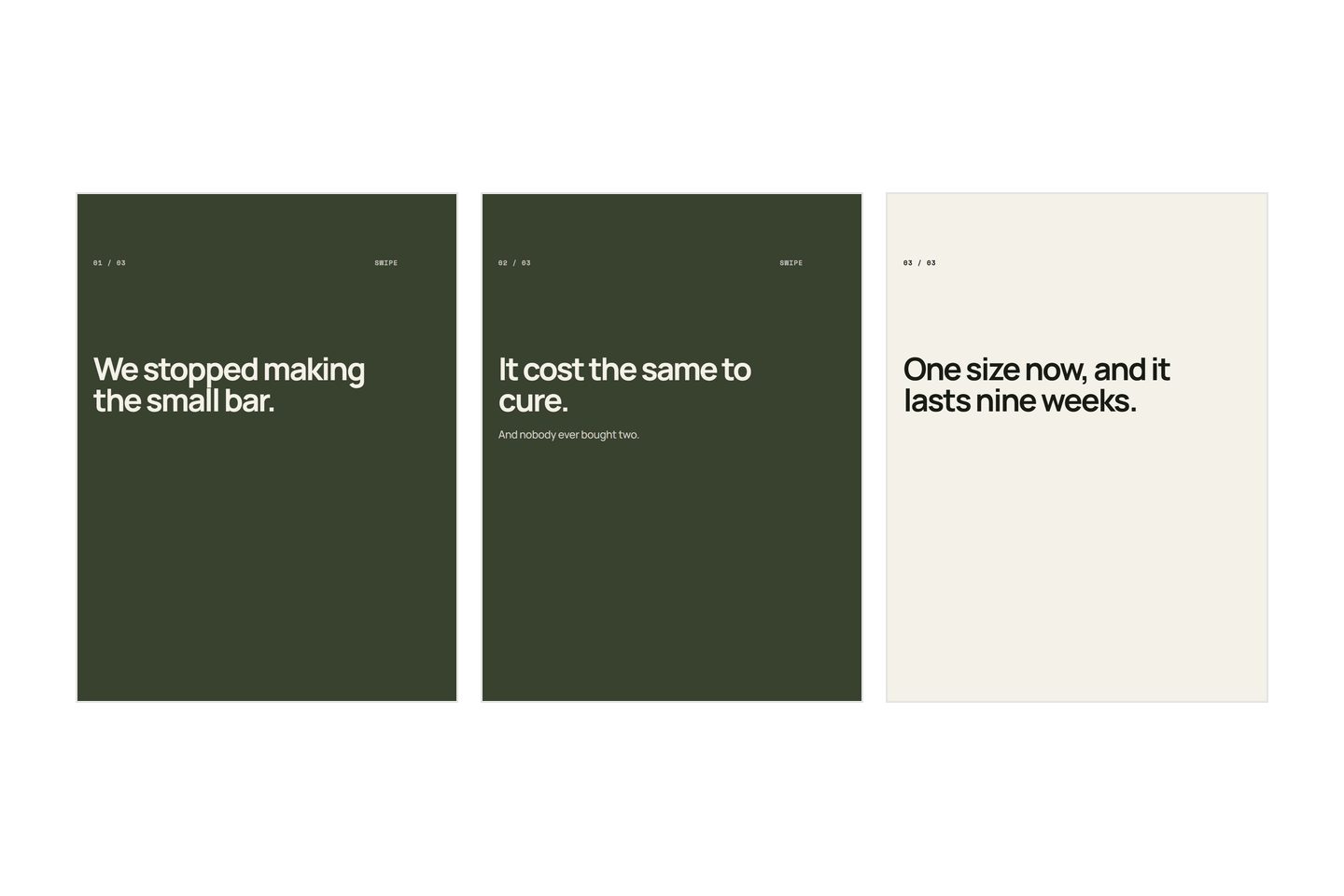
Say both out loud and the difference is obvious. "My candle" is not a sentence. "This candle takes four days, because the wax has to cure before the second pour" is a sentence. It is also a post, and it is also about three slides, because it has a claim, a reason and a doubt somebody will now have.
So "what do I post" is the wrong question, and it is wrong in a way that keeps you looking in the wrong place, which is your camera roll. The question that has answers in it is "what do I know that a stranger does not", and that material is not stored anywhere you have been looking.
Underneath sits the reason it feels like there is nothing there. You have handled this thing every day for two years. The facts a stranger would find surprising are precisely the facts you repeat most often, and repetition is what makes a fact invisible to the person repeating it. Ask anybody who makes something what is interesting about it and they will say not much, really. Ask them why it costs what it costs and they will talk for ten minutes without stopping.
Then there is the format. A single image holds one impression and is finished, which is why nine of them exhaust a product. A sequence holds a claim, the reason for the claim, and the objection to it. That is why one product supports a carousel a week and only ever one genuinely good single picture.
The fix
Where the lines come from
Twenty minutes, a pen, and single lines rather than finished posts. Seven places to look, and the first two will give you more than the other five together.
- The messages you have already answered. Scroll your inbox. Any question asked twice is a post, and the writing is half done: their question is the first slide and your reply is the rest of it.
- The decisions. Every choice that could plausibly have gone the other way. Why this size, why this material, why you stopped making the small one, why there is no plastic in the parcel. A decision has a reason behind it, a reason is an argument, and an argument is what a run of slides is for.
- The failures. The batch that went in the bin, the first version, the part that took four attempts. This is the most persuasive material you own and the least likely to get posted, for reasons that are completely understandable and still wrong.
- Who it is not for. Name the buyer who should not buy this, and say what they should buy instead. People read that one to the end, including the people it is for, because it is the only thing in the feed that is visibly not trying to sell them something.
- The process, one step at a time. Not a montage. One named step and the reason it takes as long as it does. Curing, resting, drying, the second coat, the week it sits in a rack doing apparently nothing.
- What it actually gets used for. Including the uses you did not design. Ask three customers and one of them will hand you something you have never thought of.
- The numbers. How long, how many, how far, how much of what, how many you have made since you started. A number is the cheapest thing you can put on a slide and hardly anybody puts one there.
Write until there are twenty lines. Twenty is one sitting, and it is roughly two months of posting.
Turning a line into a post
A line is not a post yet. What it becomes depends on how much working it needs shown.
| The line you wrote | What it wants to be |
|---|---|
| A fact a stranger can check in one look | One picture, the fact as the caption |
| A fact that sounds like a boast until it is explained | A short run: claim, reason, proof |
| A question you are asked constantly | Their question, your honest answer, the exception |
| A decision with a trade-off in it | What you chose, what it cost, why anyway |
| Five facts in no particular order | Nothing yet. Pick one |
That last row catches nearly everyone. Five true things in no order read as a specification sheet, and a reader can stop anywhere without losing the thread. Order is the thing that stops them. Cover the pictures, read the words aloud in sequence, and if two of them swap without damage you have a list rather than an argument. The shape that holds is worked through in what to put on a product carousel, slide by slide.
Keep the words as type laid over the picture instead of generated into it. You will want to change a word, and changing a word should not cost you a new picture.
You will still need something to look at, and the same twenty lines tell you which pictures you are short of. Six photographs answering six different questions is the floor, and most people have nine versions of the first one.
What is still broken
The method hands you subjects, not finished posts. Twenty lines is twenty starts, and each one still needs somebody to sit down and write the slides. That hour does not disappear. It stops being an hour of staring, which is a different thing from being free.
Some products are genuinely thinner than others. If you resell rather than make, the workshop lines are not yours to write, and the honest source moves to the customer: what they asked before buying, what they did with it afterwards, what came back and why.
And if there is no product at all, the twenty lines come from somewhere else entirely: not the workshop but the corrections you make every week. What to post when you do not sell a product is the version of this for a trade, a practice or a class.
The best lines are usually the ones you would rather not post. The price reasoning, the failed batch, the person who should buy something cheaper. Nobody can make you use them, and twenty lines with all of those crossed out is a return to adjectives by a longer route.
And none of this touches the real reason accounts go quiet. If you are three weeks behind on orders, twenty lines will sit in a note on your phone exactly as long as the empty caption box did.
What it does fix is the belief that you have run out of things to say, which is almost never true and is expensive while you hold it. A pen, twenty minutes, and your own sent messages. The person who knows the most about what you sell has been in the room the entire time, photographing the underside of it.
Written by the Kloti team. Kloti writes and designs a carousel about your work, and the caption to post it with. The pictures on this page were generated in Kloti.